Showing posts with label a320 family. Show all posts

Monday, 26 May 2014

Airbus A320-233

This is the Airbus A320-233 by 'Paul Glanville'.

(A320 by 'riviere' here)

The A320 series has two variants, the A320-100 and A320-200. Only 21 A320-100s were produced; these aircraft, the first to be manufactured, were only delivered to Air Inter (later acquired by Air France) and British Airways (as a result of an order from British Caledonian Airways made prior to its acquisition by British Airways). Compared to the A320-100, the primary changes on A320-200 are wingtip fences and increased fuel capacity for increased range. Indian Airlines used its first 31 A320-200s with double-bogie main landing gear for airfields with poor runway condition which a single-bogie main gear could not manage. Typical range with 150 passengers for the A320-200 is about 3,300 nmi (6,150 km). It is powered by two CFMI CFM56-5s or IAE V2500s with thrust ratings between 113 to 120 kN (25,400 to 27,000 lbf). The lowest speed an A320 can fly is approximately 207 km/h.

This aircraft is fun to fly, and comes with many liveries. It has a 2d and a 3d cockpit, with the passenger cabin also being rendered.

Below is the list of liveries:
The passenger cabin

The 3d cockpit

The 2d cockpit

Mexicana livery

Avianca livery

JetBlue livery

Air Inter Europe livery

Air Inter livery

Air Canada turquoise livery 

Air Canada livery

Afriqiyah livery

TACA livery

Sunday, 18 May 2014

Airbus A318

This is the Airbus A318 by 'riviere'.

The Airbus A318 is the smallest member of the Airbus A320 family. The A318 carries up to 132 passengers and has a maximum range of 3,100 nmi (5,700 km; 3,600 mi). The aircraft entered service in July 2003 with Frontier Airlines, and shares a common type rating with all other Airbus A320 family variants, allowing existing A320 family pilots to fly the aircraft without the need for further training. It is the largest commercial aircraft certified by the European Aviation Safety Agency for steep approach operations, allowing flights at airports such as London City Airport. Relative to other Airbus A320 family variants, the A318 has sold in only small numbers with total orders for only 81 aircraft placed as of 31 December 2012.

This aircraft is fun to fly, and but only comes with 1 livery (Not counting the default one). More liveries are possible to acquire though. It has a 2d and 3d cockpit, with the passenger cabin also rendered, which is a nice touch. Using reverse thrust and arming speed brakes is possible.


Airbus A320

This is the Airbus A320 by 'riviere'.

The A320 series has two variants, the A320-100 and A320-200. Only 21 A320-100s were produced; these aircraft, the first to be manufactured, were only delivered to Air Inter (later acquired by Air France) and British Airways (as a result of an order from British Caledonian Airways made prior to its acquisition by British Airways). Compared to the A320-100, the primary changes on A320-200 are wingtip fences and increased fuel capacity for increased range. Indian Airlines used its first 31 A320-200s with double-bogie main landing gear for airfields with poor runway condition which a single-bogie main gear could not manage. Typical range with 150 passengers for the A320-200 is about 3,300 nmi (6,150 km). It is powered by two CFMI CFM56-5s or IAE V2500s with thrust ratings between 113 to 120 kN (25,400 to 27,000 lbf). The lowest speed an A320 can fly is approximately 207 km/h.

This aircraft is fun to fly, and comes with 3 liveries. It has a 2d and 3d cockpit, with the passenger cabin also rendered, which is a nice touch. Using reverse thrust and arming speed brakes is possible.


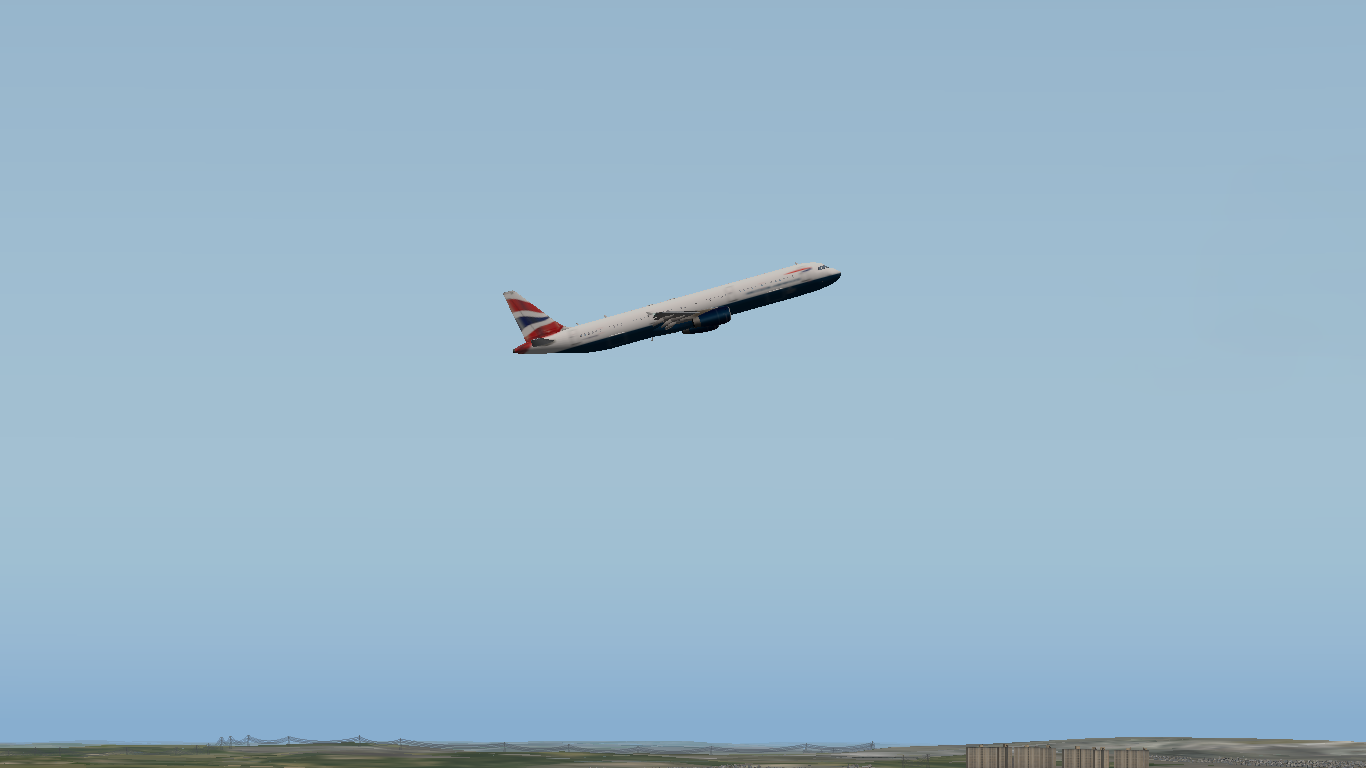
Airbus A321

This is the Airbus A321 by 'riviere'.

The Airbus A321 is a stretched first derivative of the standard A320. The variant was launched in 1988, when the A320 began operations. Compared with the A320, the A321's major change is the stretched fuselage, which is lengthened by 6.94 metres (22 ft 9 in); the A321 is the largest of the A320 family. This is achieved by adding a front plug immediately forward of wing 4.27 m (14 ft 0 in), and a 2.67 m (8 ft 9 in) rear plug. To maintain performance, double-slotted flaps were included, in addition to increasing the wing area by 4 m2 (43 sq ft), to 128 m2 (1,380 sq ft).[49] Other minor modifications were made to accommodate the A321-100's 9,600 kg (21,200 lb) increase in maximum takeoff weight to 83,000 kg (183,000 lb). The maiden flight of the first of two prototypes came on 11 March 1993. The A321-100 entered service in 1994.

This aircraft is nicely rendered and comes with 3 liveries. It has both a 2d and 3d cockpit, and the passenger cabin is rendered, which is a nice touch.